
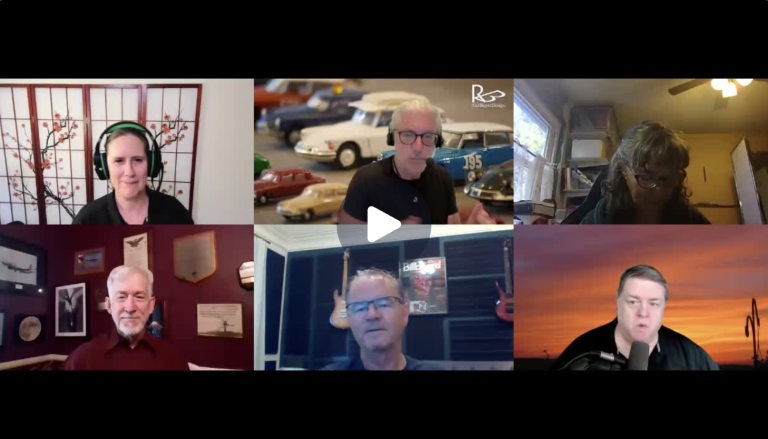
Open Friday Coffee | Recorded on: August 14, 2026
Special Guest: Mark Hardcastle, author of The Symphony of Your Life: Restoring Harmony When Your World Is Out of Tune
Sometimes life doesn’t need to be brought back into balance.
It needs to be brought back into harmony.
This week on Open Friday Coffee, I invited my longtime friend and fellow author Mark Hardcastle to join us. Mark spent 40 years flying at 35,000 feet—first as a military pilot and later as a United Airlines captain. He is also a musical conductor, an entrepreneur, and the author of The Symphony of Your Life.
Those careers may sound completely unrelated.
They’re not.
As Mark put it, if something goes wrong at 35,000 feet, you can’t pull over to the side of the road. You have to keep the airplane flying while you figure out what went wrong.
The same thing happens when you’re conducting music. If the performance begins to fall apart, you don’t stop everything. You keep the music moving while finding a way to bring the musicians back together.
And, goodness gracious, isn’t that life?
Sometimes the goal isn’t to stop everything until we have all the answers.
Sometimes our job is simply to stay in the process long enough to find our way back into harmony.
Five Ideas to Take With You
1. Harmony is more useful than balance.
A meaningful life has a lot of moving pieces. They aren’t all going to receive equal attention at the same time.
Harmony allows different parts of your life to become louder or softer depending upon the season while still remaining part of the same composition.
You don’t need perfect balance.
You need to be able to find your center again.
2. Conventional wisdom is information—not a command.
One of my favorite parts of Mark’s book is his discussion about being “right” versus being “wise.”
His football story illustrates something entrepreneurs encounter all the time: sometimes the conventional play is statistically wise—and still isn’t the right play for the situation you’re actually facing.
This reminded me of something my father taught me:
Research your own experience.
Absorb what is useful.
Reject what is useless.
Add what is specifically your own.
Learn from the playbook.
Then pay attention to the field you’re actually standing on.
3. Being right can have a cost.
Mark added an important nuance to this idea.
There are circumstances where applying your own experience instead of conventional wisdom is exactly what is needed.
And there are other circumstances—especially in relationships—where winning the argument can cost you the larger relationship.
Sometimes being right isn’t the win.
Harmony is.
Wisdom includes knowing the difference.
4. The conductor’s most important work happens before anyone sees the performance.
Mark described the conductor primarily as a teacher.
By the time the orchestra or choir walks onto the stage, much of the conductor’s real work has already happened.
The music has been studied.
The meaning has been understood.
The musicians have been taught.
The group has practiced.
And the conductor has helped people understand not only what they are performing, but what they are trying to communicate.
Leadership often looks like that.
The visible moment isn’t necessarily where the most important work happens.
5. Stay in the process.
Before we closed, I asked Mark what he wanted to leave with us.
His answer was wonderfully simple:
Stay in the process.
Get clear about what you want.
Figure out how you might get there.
Begin.
And then keep going.
You do not have to know the whole composition before you play the next measure.
You only need enough clarity to continue.
Your Reflection
Think about one area of your life or business that currently feels a little “out of tune.”
Ask yourself:
What am I actually trying to create here?
Then consider:
What have I learned from my own experience?
Where might I be following a playbook that no longer fits?
What would bring greater harmony—not necessarily greater balance—to this situation?
And finally:
What is one small action that allows me to stay in the process?
You don’t have to fix the entire symphony today.
Just play the next measure.