
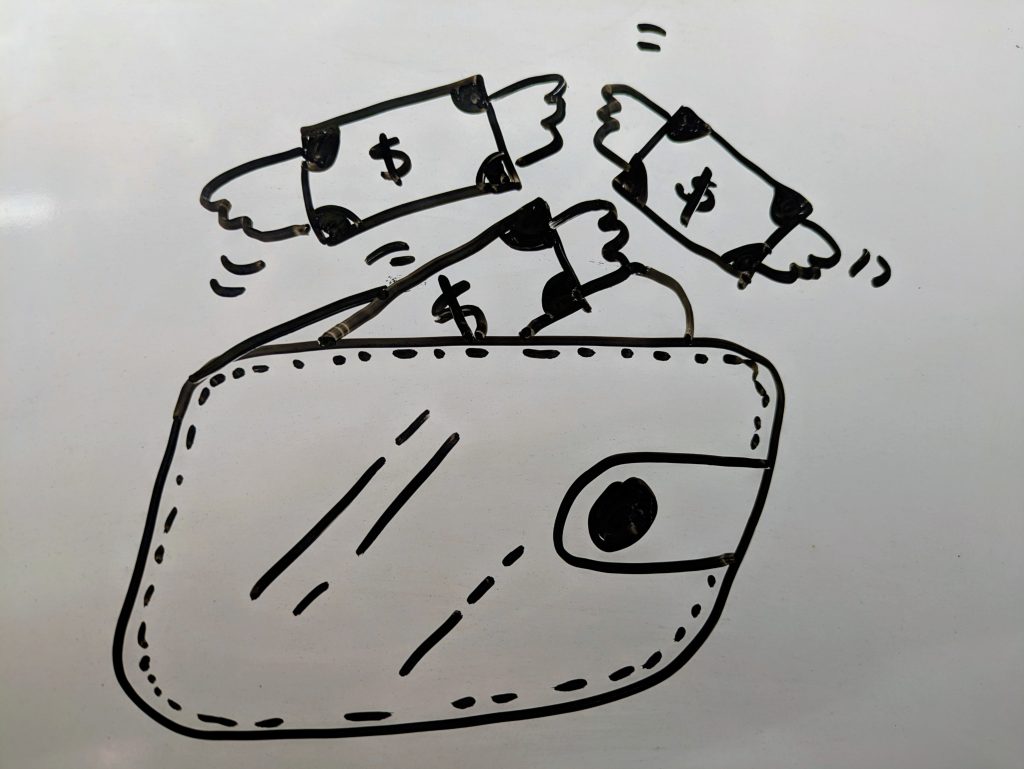
Spend Freely on What Matters. Stop Unconsciously Funding What Doesn't
When people decide they need to improve their finances, they often start looking for things to cut.
Coffee.
Restaurants.
Subscriptions.
Vacations.
Anything enjoyable immediately becomes suspicious.
I don’t think that is particularly useful.
The goal is not to make your life smaller so your bank account can become larger.
The goal is to become more deliberate about where your money goes.
There is a significant difference between:
“I need to stop spending money.”
and:
“I want my spending to reflect what actually matters to me.”
One creates deprivation.
The other creates direction.
That distinction matters because you are probably going to spend money for the rest of your life.
So rather than trying to become someone who barely spends, let’s become someone who spends intentionally.
Spending Is Not the Enemy
Money has jobs.
Some of it supports your future.
Some reduces debt.
Some builds savings.
Some gets invested.
Some creates things.
Some gets given away.
And some of it exists specifically to support the life you are living today.
You need food.
You need shelter.
You need transportation.
You need clothing.
And occasionally you want dinner with a friend, a good book, a comfortable pair of shoes, a beautiful plant, concert tickets, or something completely ridiculous that makes you laugh every time you look at it.
Fine.
Money is supposed to participate in your life.
The question is not whether you should spend.
The better question is:
Am I spending deliberately, or am I spending automatically?
The Expensive Part Is Often What You Stop Seeing
Some of the easiest spending to change is not the dramatic purchase.
It is the spending you no longer notice.
Years ago, I worked with a woman who was trying to find places where she could reduce her expenses.
She had tracked her spending, and we started looking through the ordinary things she purchased.
One of them was paper towels.
She knew exactly which brand she liked and how quickly her household went through them.
When we calculated the annual expense, those paper towels were costing her roughly $520 a year.
Paper towels were not destroying her financial life.
That wasn’t the point.
The point was that she had never considered the expense because it was simply part of the background.
That is where intentional spending begins.
Not:
“Paper towels are bad.”
But:
“Is this worth $520 a year to me?”
Maybe the answer is yes.
Great.
Now it is a choice.
Maybe the answer is:
“Good grief. No.”
Also useful.
Turn Small Purchases Into Annual Numbers
One of my favorite tricks with recurring expenses is to stop looking only at the price of the individual purchase.
Annualize it.
Something that costs $10 a week is approximately $520 a year.
A $25 monthly subscription is $300 a year.
A $50 habit every week is roughly $2,600 a year.
Again, none of those numbers automatically means:
Stop buying it.
It means:
Now you know what you’re actually spending.
And knowing gives you a real choice.
Would I rather spend $2,600 a year on this?
Or would I rather send $2,600 toward something else I say matters to me?
That is a far more useful question than whether a $50 purchase is “good” or “bad.”
Use the Pause
Impulse buying works because the time between wanting and buying becomes very short.
See it.
Want it.
Click.
Done.
So one of the simplest ways to change your spending is to make that space longer.
For larger purchases, pause.
You can establish whatever threshold works for you.
Perhaps anything over $100 gets a waiting period.
During that pause, ask yourself some questions.
Do I actually need this now?
Do I already own something that does this job?
Where will I put it?
Will I use it often enough to justify the cost?
Am I buying it because I want the item—or because I want the feeling I think the item will give me?
Can I borrow it?
Rent it?
Buy it used?
Wait until it goes on sale?
If I still want this tomorrow, will it still be available?
And one of my favorites:
What am I choosing not to fund if I buy this?
That last question connects spending directly back to what you said you wanted.
“Can I Afford It?” Is Not Always the Best Question
You may absolutely be able to afford something.
That does not automatically mean you want to spend your money on it.
There is a tremendous difference.
“Can I afford this?” asks whether the money exists.
“Do I want to fund this?” asks whether the purchase deserves some of your resources.
That is financial maturity.
You may have $1,000 sitting in an account and still decide:
I don’t want to use $300 of it for that.
Not because you are broke.
Not because you are frightened.
Because you have something else you value more.
That is what intentional spending looks like.
Become a Conserver, Not a Depriver
I have taught the idea of the conserver lifestyle for years.
Conserving is not the same thing as denying yourself everything you enjoy.
A conserver looks at resources and asks:
How do I get full value from what I already have?
That might mean:
using something longer,
repairing instead of immediately replacing,
using what is already in the pantry,
wearing what you own,
borrowing something you only need once,
sharing equipment,
buying a quality item that lasts,
or simply not replacing something that doesn’t actually need replacing.
This is not about hoarding old things or refusing to modernize.
It is about breaking the habit of automatically turning every inconvenience into a purchase.
Sometimes the solution is not:
Buy another thing.
Sometimes the solution is:
Use what you have differently.
Don’t Confuse a Sale With Saving Money
This one makes me laugh because retailers are very good at convincing us that spending money is somehow the same thing as saving it.
You walk into a store intending to spend $40.
You leave having spent $90.
But the receipt says:
YOU SAVED $62!
No.
You spent $90.
Maybe you received excellent value.
Maybe those purchases were planned.
Wonderful.
But money only moves into savings when you actually save the money.
If something normally costs $100 and you purchase it for $70, you did not magically acquire $30.
You spent $70.
If you want the $30 savings to become real, move $30 somewhere meaningful.
Put it into savings.
Send it toward debt.
Invest it.
Give it another job.
Otherwise, it was simply a discount.
There is nothing wrong with that.
But use accurate language.
Grocery Shopping Is a Great Training Ground
Groceries are particularly useful because they are purchased frequently.
That gives you lots of opportunities to practice intentional spending.
The goal isn’t necessarily to buy the cheapest food available.
It is to stop paying for food you don’t eat.
Buying things no one in the house actually likes is not saving money.
Letting produce rot in the refrigerator is not saving money.
Buying three of something because it was on sale when you only use one is not saving money.
Neither is wandering through the store hungry without a plan while putting whatever looks good into the cart.
Intentional grocery spending might mean:
checking what you already have,
planning around food that needs to be used,
knowing which items your household consistently consumes,
comparing actual unit prices,
stocking up selectively,
and getting the people who eat the food involved in the process.
You are not merely trying to reduce the grocery bill.
You are trying to increase the amount of value you receive from the money you spend on food.
That is a different goal.
Get the Household Involved
Money systems are much harder when one person is attempting to create them for everyone else.
If several people are using the resources, let them participate.
Children can learn remarkably early that households make choices.
You don’t need to create fear around money.
You can simply say:
“We have this amount available for groceries this week. What meals would everybody like?”
Or:
“We can do this activity or that activity. We aren’t doing both. Which matters more?”
That teaches something far more useful than:
“We can’t afford anything.”
It teaches prioritization.
Resources are finite.
Choices are real.
And families can make those choices together.
Stop Trying to Save Money Everywhere
This may sound strange coming from someone who has spent decades teaching people about money.
I do not think you need to optimize every purchase.
That sounds exhausting.
There are areas of my own life where I am perfectly willing to pay for convenience.
There are products I prefer.
There are services that save me enough time or frustration that I happily pay for them.
That is not financial failure.
Remember the larger goal:
Spend freely on what matters. Stop unconsciously funding what doesn’t.
If excellent coffee matters to you, buy excellent coffee.
Then perhaps stop paying for five subscriptions you forgot you had.
If travel matters deeply to you, fund travel.
Maybe that means you drive your car several years longer.
If books matter, buy books.
Perhaps your home décor doesn’t need to change every season.
Your priorities do not have to look like mine.
They simply need to be yours.
Watch for Emotional Shopping
Sometimes we are not purchasing an object.
We are purchasing a feeling.
Comfort.
Status.
Belonging.
Reward.
Control.
Hope.
A new notebook is going to make me organized.
A new outfit is going to make me confident.
This course is going to turn me into the person who finally succeeds.
This kitchen gadget is going to transform dinner.
Sometimes the purchase genuinely helps.
Sometimes we are trying to buy our way into an emotional state.
Before an impulse purchase, try asking:
What am I actually wanting right now?
Perhaps you are bored.
Perhaps you want a reward after a difficult week.
Perhaps you feel left out.
Perhaps you are tired.
Perhaps you genuinely want the thing.
Fine.
But knowing which one it is allows you to make the purchase from awareness rather than reaction.
A Cheap Item You Don’t Use Is Expensive
Price and value are not the same thing.
Something can cost very little and still be a waste of money.
Something can be expensive and provide extraordinary value for years.
The goal is not to always buy the cheapest thing.
Ask:
How often will I use this?
How long will it last?
Does it solve a real problem?
Does it reduce another expense?
Does it improve something I care deeply about?
Does it save meaningful time?
Is it well made?
Would I buy this if nobody else ever saw it?
Those questions move you away from price alone and toward value.
Give Yourself Money to Enjoy
One reason people rebound from extremely restrictive financial plans is that there is no room to be human.
Everything becomes:
No.
Can’t.
Shouldn’t.
Bad.
Eventually, somebody gets tired of living that way.
So build enjoyment into the plan.
You are allowed to spend money for no better reason than:
I like this.
The difference is that now it has a place.
The purchase isn’t sabotaging your emergency savings.
It isn’t going onto a credit card you cannot pay.
It isn’t secretly competing with something you say is more important.
It is simply money you deliberately chose to enjoy.
That is a healthy financial system.
Every Dollar Does Not Need an Interrogation
Intentional spending does not mean standing in a grocery aisle performing an existential analysis over a jar of mustard.
We are trying to make your financial life easier, not stranger.
The more often you make deliberate choices, the more automatic they become.
You know which things matter to you.
You know where you don’t mind spending.
You know where money tends to leak.
You know which purchases regularly disappoint you.
You know what you are building.
That knowledge gradually becomes a way of operating.
You don’t need to think quite so hard.
Spending Should Support the Life You Are Building
This is where everyday spending connects to Revenue Without Rush.
We are not trying to squeeze every possible dollar out of your present life so some imaginary future version of you can finally enjoy it.
Your present life matters.
Your future matters too.
Harmony means supporting both.
That might mean dinner with a dear friend tonight and money invested for retirement.
A vacation this year and an emergency reserve.
A beautiful pair of shoes and reducing debt.
There is room for enjoyment and responsibility in the same financial life.
The skill is learning how to choose deliberately.
Try This for One Week
For the next seven days, don’t try to change everything you spend.
Just notice.
Every time you purchase something that wasn’t completely routine, ask:
Why am I buying this?
That’s it.
No guilt.
No spreadsheet required.
No punishment.
Just curiosity.
At the end of the week, look back.
Which purchases were useful?
Which brought genuine enjoyment?
Which solved real problems?
Which ones do you barely remember making?
That little exercise will tell you more about your spending than a dozen lectures about skipping coffee.
Because the point isn’t to spend as little as possible.
The point is to stop directing your money toward things that don’t matter while telling yourself you don’t have enough for the things that do.
Know what matters.
Fund it.
Let the rest become optional.
That is everyday spending with intention.
Listen
Rein in the Impulse Buying Monster
A short Three Minute Money Tip about interrupting impulse purchases and creating enough space to make a deliberate decision.
Examine Disposable Products
In this episode of The Practical Mystic Show, I use a wonderfully ordinary example—paper towels—to show how small recurring expenses become significant when you calculate them across an entire year.
Read Next
Know What Your Money Is For
Intentional spending becomes much easier once you know what you want your money to help you build.
The 60/40 Principle of Money Management
Give your money more than one job by supporting your present life while deliberately building financial stability for tomorrow.
Continue the Journey
This article is part of Revenue Without Rush — Level 1: Financial Footing.
Level 1 is about learning to direct your money deliberately—reducing debt, building savings, understanding your spending, and creating a financial floor strong enough to support what comes next.
[Explore Revenue Without Rush →]
This material is educational and is not individualized financial, investment, tax, or legal advice.